Do You Remember Sudan: Constructing Sudanese-Armenian visual culture
This article was originally written and published in English and Arabic in the ‘The Muse Magazine Issue 03: On Borders & Intersections’ an annual magazine by the The Muse Multi Studios. Here we present an extended version of the article from the magazine. It has been republished with their permission. You can purchase a copy of the magazine and support their work via the link here and follow them on social media here.

Description: A ceremony for the laying of the foundation stone of the Armenian Church of Khartoum in 1954
Location: Khartoum, Sudan
Source: sudanahye archive via private collection
There is a group on Facebook called ‘Do You Remember Sudan’. In this group people post photos of Sudan from beyond decades. The approximately 10,000 members of this group can then comment on the photos with remarks on the place in the photo or perhaps a memory of time spent there. Quite often the comment is just a simple ‘good old days’. The group also has a significant presence from the foreign communities for whom Sudan was a host for their diasporas including Sudan’s Armenian community. Subsequently the group has been helpful for ‘sudanahye’, the Sudanese-Armenian Heritage Project, our project which is developing an archive of Sudanese-Armenian life and researching it to develop a holistic history and legacy for this community.
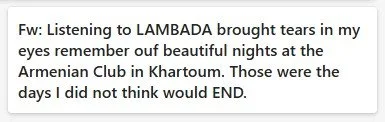
Description: An email from a Sudanese-Armenian
Location: NA
Source: Vahe Boghosian 2026
Facebook groups are not a typical resource for research projects. But in light of a lack of historical sources and inaccessibility of archive material in Sudan, it is critical for growing our archive and filling the gaps in our knowledge via community contributions. But while scouring this page, there is one emotion that is conveyed by almost every photo and every comment: nostalgia.
Nostalgia is a feeling, but at its core is linked to the visual, we see pictures and it triggers our nostalgic memories. Or we hear a story and it lets us imagine and visualise our past, our memories are ‘seen’. Time and time again on the Facebook group there are comments that state something to the effect of: ‘its amazing how a photo can bring back memories’. Of course, what the ‘visual’ means has changed significantly in the past half century and new technologies have created a world where the visual is in abundance. It is a world defined more than ever by optics, one where aesthetics is the medium with which we view ourselves and a world where interconnectedness has pushed the neccessity of visual culture, whether it be a personal brand, a corporate one, or a national one, to new extremes. What will the ‘Do You Remember Sudan’ group look like in 50 years time, when we all have an abundance of photographs or videos? How easily will our nostalgia be triggered?
One of the objectives of ‘sudanahye’ is also to re-imagine the community in contemporary social and cultural contexts. The ‘Do You Remember Sudan’ group remember the community and we hope the project will enrich their knowledge of the past. But they are not the generation that will use an understanding of history to imagine and build a better future. But to achieve this objective of progressing from a static representation of the past to a more dynamic re-imagining of the community, a re-imaging that provides a reflection point on Sudan’s history as a pluralist host for diaspora communities, it is necessary to construct the community’s visual culture.
But Armenians in Sudan were not artists or artisans. Most of them came to Sudan to find safety and belonging in as their homeland was destroyed and taken from them by the Ottoman Empire in the Armenian Genocide. The community negotiated colonial hierarchies to secure themselves an enviable position within Khartoum’s cosmopolitan upper classes. They generally maintained this position and demonstrated resilience to political upheaval to survive as a community until 2023, albeit with significantly reduced numbers. But they did not produce visual art - their visual culture is invisible not by erasure but by absence. But where we lack art, we have nostalgia - that very diasporic emotion.
A Diasporic Emotion
Archiving is a means to preserve memories. Analysing the archive is a means to researching history. The sudanahye archive is intertwined with nostalgia - by searching through nostalgia, the visual memories, can we construct a visual culture for the community?
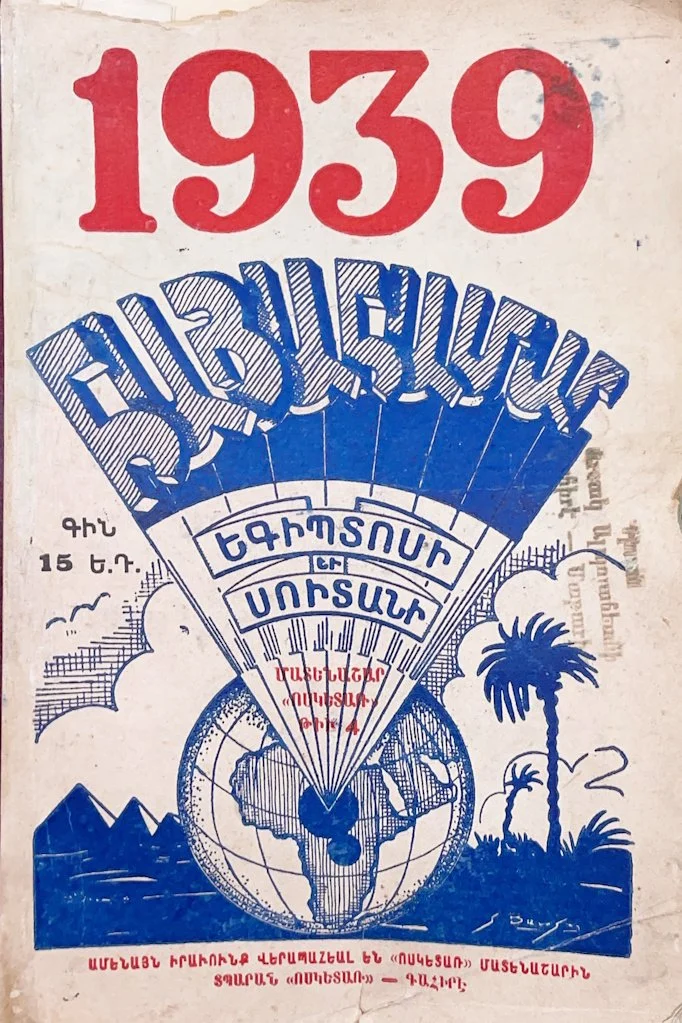
Description: ‘Hayahumar Yegipdos yev Sudan’ 1939 (Directory Egypt and Sudan 1939)
Location: Cairo, Egypt
Source: From the archive of Souren Bairamian
Nostalgia comes from the Greek word ‘nostos’, meaning a desire to return home, and ‘algos’ - pain. Johannes Hofer coined the term in 1688 to capture feelings of estrangement in the foreign, and the painful emotions of longing people had for home, essentially a neurological disorder of homesickness. In the 18th and 19th century it began to be reinterpreted as a beautiful sorrow, a profound emotional experience tied to memory and a longing for a beautiful past. As industrialisation and urbanisation took hold, it often was applied to a longing for nature and a pre-industrial life. In the era of empires, for the colonised nostalgia was for a simpler time free of oppression, for the colonisers, nostalgia would become linked to imperial memory, better days of the past when imperial powers exported their ‘civilising mission’ to exoticised lands. In the era of mass media and consumer capitalism, nostalgia as an aesthetic was born - Pinterest can allow one to make a ‘vintage Sudan’ mood board to guide their interior design style, corporations now use retro styles or heritage branding to appeal to the generation who perhaps prefer looking back rather than looking forward at future stolen by technology, wars, climate change and consumer capitalism - a generation for whom the future is dark and clouded.
Svetlana Boym in her book The Future of Nostalgia (2001) distinguishes between ‘restorative nostalgia’ that seeks to rebuild a lost home or reclaim previous greatness, and ‘reflective nostalgia’ which dwells in longing and integrates the nostalgia as part of identity. For Sudanese-Armenians, the nostalgia is reflective - the Armenian indigenous homeland now in eastern Turkey barely has traces remaining of thousands of years of Armenian history. This loss has come to define Western Armenian identity - those who survived the Genocide and sought shelter in the Mdidle East or further afield.
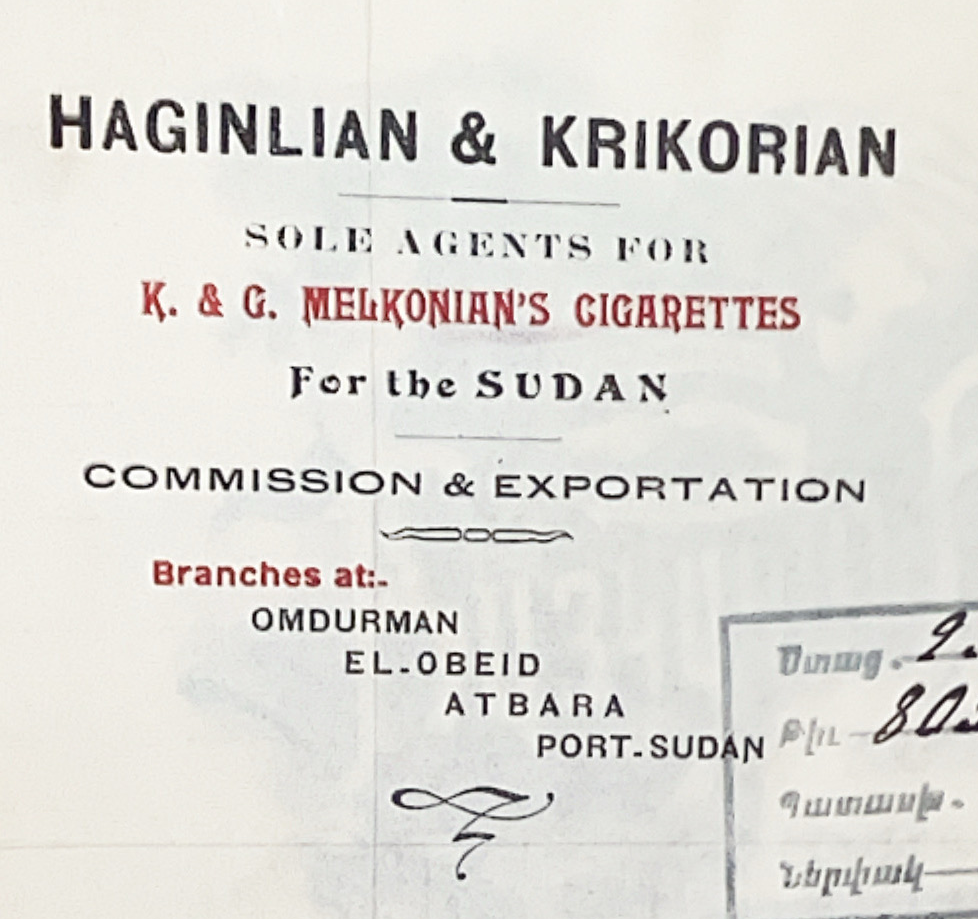
Description: A letterhead for the company of Hangilian and Krikorian
Location: Khartoum, Sudan
Source: AGBU Archive Cairo
For millions of Sudanese outside of Sudan, perhaps now is the time when a shift is taking place. Previously there was a ‘restorative nostalgia’, with people planning a return to Sudan, perhaps financed with wealth from elsewhere to live their simpler days again in a life more attuned with culture and nature. With the war it seems many have resigned themselves to a life in foreignness. Decades of maintaining hope of a return to better days is exhausting. A Sudanese diaspora identity continues to take shape, something stemming from but distinct from Sudanese culture. It may manifest via youth speaking with even more loan words from American pop culture. It can also manifest through a manner of ‘self-orientalisation’, where people born and raised in foreignness exoticise their own culture and traditions because it was a world where they weren't foreign, somewhere they belonged. Or maybe it will be via a new diaspora culture which sees people clinging to anything that links one to their culture to avoid getting lost in multi-lingual babylons where many cultures are allowed to exist and be celebrated, and yet seemingly a new globalist mono-culture has emerged to dominate over them all. Perhaps this diaspora culture is one where speaking to the older generations is a ‘project’ and cooking the food your family taught you is ‘content’ rather than part of your day to day existence. And yet all this is necessary, in today’s world diaspora culture is not given, it is constructed through the actions of the diasporans.
Armenians know this, because we have experienced this. Our diaspora has been detached from our homeland, much of which is now in Turkey, for over a century. We have been estranged from the country of Armenia, an imagined homeland which to many is unrecognisable as a home following 90 years of Soviet colonisation - we have become a quintessential diaspora. We have nostalgia for a lost world, we have a rich vocabulary to describe migration, we have books and songs about living in ‘foreignness’, we even have sub-cultures upon sub-cultures to categorise Armenians from one county of Los Angeles to the other. We have nostalgia, a collective nostalgia passed down to generations who each have our own identity crisis, each one unique, yet all in the broader picture the same. The nostalgia is not just for the homeland, but now also as in the case of those Armenians in the ‘Do You Remember Sudan?’ group, a nostalgia for the countries that hosted our diaspora communities. And it is this nostalgia that contains the building blocks of the Sudanese-Armenian visual culture, what they remember and how they remember it is the key to constructing a visual culture that represents the story of their community.
But how do we breakdown nostalgia into its constituent parts? What forms the nostalgic view of the Sudanese-Armenians? Based on our archive we have identified three parts. Firstly commerce - the economic roles the Armenians had which was the building block of their community and the first visual traces passed down to us. Secondly, architecture - the spaces which Armenians remember most, places designed for a community born out of its economic role. And thirdly, photographs - the capsule for memory and nostalgia and an industry where Armenians had an outsized impact on the role of photography in Sudan.
The art of the commerce

Description: A advertisement for ‘Puzant the Tailor’ in the ‘Sudan Directory 1939’
Location: Khartoum, Sudan
Source: Tthe Sudan Archive at Durham University

Description: The letterhead for ‘Barsamian Motors Limited’
Location: Khartoum, Sudan
Source: sudanahye archive via private collection
The majority of Armenians in Sudan worked with commerce. They were merchants and traders, and to succeed in business they developed visuals to advance their business interests. With the entrenchment of the British colonial system came the development of a formal service industry and associated form of advertisements. The advertisements of the Armenian businesses speak not only to the types of businesses they were operating, but also the middle-upper class, cosmopolitan lives they lived. In addition to advertisements,some Armenians took effort to develop letterheads that would stand out. Letterheads, advertisements and even wedding invitations use fonts which reflect the prevailing art deco styles of the first half of the 20th century. The leveraging of this style reflects the community's economic, social and cultural connection to Egypt’s Armenian community - their gateway to the outside world. Back then, a Sudanese-Armenian’s trip to Alexandria in the summer was part shopping trip and part an opportunity to learn of the latest trends. Later letterheads display more Arabic styles as Armenians adapted to the changes in the country following the end of the colonial era. The visuals stemming from Armenian commerce in Sudan, speak to the community’s nature but also how the community was built. It was the invoices, telegrams and adverts sent on those letterheaded papers that funded the building of community buildings, that gave birth to sports teams, or allowed picnics on the Nile. The commerce, represented by its artwork, gave way to the community’s life - the object of nostalgia.
The space of memories
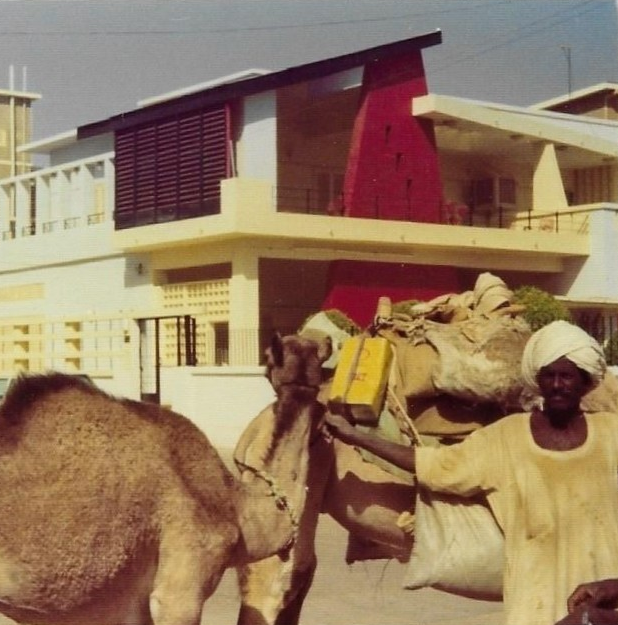
Description: The home of a Sudanese Armenian businessman in Khartoum
Location: Khartoum, Sudan 1977
Source: sudanahye archive via private collection
As Armenians accumulated wealth and became entrenched as part of Sudan’s society they invested their wealth in grand villas - whether it be a house with a veranda and pillars from the 1930s or a modernist balconies from the 1970s, the Armenians who could built homes that reflected their wealth and the latest styles. Via our oral history archive of Sudanese-Armenian voices we even discovered that the Kazandjian household, home of Anton Kazandjian who founded Gordon Photo Studios, had a house in the shape of a camera.
The Armenians also invested in their community’s architecture, often on land provided by the authorities. The Armenian Church of Khartoum began construction in 1953 and was opened in 1957. With the school building attached it became a community hub and a place that lives in the memory of so many. Sudanese-Armenians remember the doors to the school building and with that comes the mischief they partook in inside or the plays they performed in in the hall. The Armenian Church has a unique design with traditional Armenian church elements including the spire or ‘kumbet’ in Armenian, but its internal structure has a shape not typical of Armenian church architecture - the story of how this Church came to be as such remains a mystery.
The Church and school now bear the scars of the RSF’s occupation. Many of the Armenian homes have been destroyed by war or replaced over the years. Many of these spaces people remember with such nostalgia exist only in the imagination of the members of the community, a venue for reminiscent dreams. The Armenian architecture of Sudan simultaneously represents the community’s geography, wealth and style and also is the venue of memories, the spaces they long to spend one more evening in, the visual setting for nostalgia.
A photographic memory
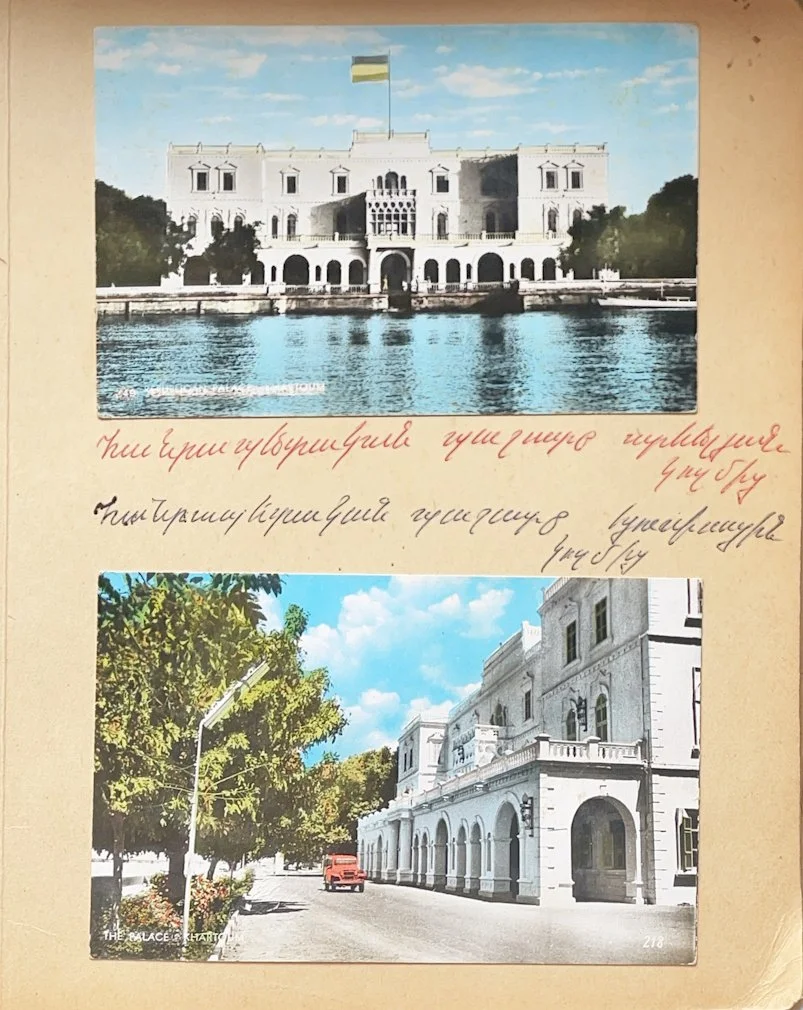
Description: Postcards from Kazandjian Studios with Armenian captions
Location: Khartoum, Sudan
Source: sudanahye archive via private collection
Armenian nostalgia is encapsulated in the Armenian photographic tradition in Sudan, both vernacular and professional. When exiled from the Ottoman Empire, the Armenians took their knowledge of photography with them to wherever they settled, they became the go to names in photography in cities such as Cairo, Gaza or Baghdad. Sudan was no exception with Armenian photo studios becoming the prominent names in the industry. Kazandjian became the official export agent and distributor for Kodak and even Rashid Mahdi, the pioneering photographer in Atbara, was first intrigued by photography having seen an Armenian photographer on a street. With prominence in the photography industry, naturally many Armenians had early access to cameras and the resources to process the photos and thus picked it up as a hobby earlier than the trend.
The Armenian photographic legacy is a unique contribution to the nostalgia of not just Armenians but also Sudanese, whether it be by thousands of personal photographic collections we are finding and digitising, the postcards of Karakashian Studios with recognisable landscapes of Sudan such as ‘the haboob’, or the plethora of Kazandjian’s photographs as official photographer for ‘the palace’in archives in Britain.

Description: Photos of the British in Sudan by Andon Kazandjian of Gordon Photography Studio
Location: Khartoum, Sudan
Source: Kew National Archives
The Armenian’s memory of the community has become cemented via photos - they are a container for memories and associated nostalgia. Often oral history sessions with Sudanese-Armenians are accompanied by photographs - in these moments the photograph is static, yet the memories around it dynamic, the photo stands still, but the individual brings the photo to life by describing the moments before and after, or the noises and atmosphere of the time.
Many of these photographs or postcards in the sudanahye archive were used as mementos to communicate with other Armenians across Sudan’s vast geographies or further afield to family members who had become spread over the world. They were used to send a visual message in an era before Whatsapp or Messenger. Many of the photos have writing, or a message on the back - oftentimes reminding the receiver far away of the world they left behind - a nostalgic note.
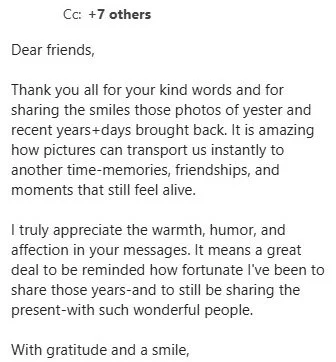
Description: An email from a Sudanese Armenian
Location: NA
Source: Vahe Boghosian 2026
The Sudanese-Armenian photographs give us the strongest indication of the community’s realities then, allowing not just those who experienced it to imagine, but us in the present to see their styles, appreciate their fashion and understand their lives. These can trigger our nostalgia for a world we never knew, a world we only heard about in the stories of our ancestors. By searching through the nostalgia associated with these photographs, we understand the elements of the visual culture that speak most to the community, the places they remember best and the design details of that place that remains most pertinent, details that upon being noticed can make a cheery nostalgic smile be accompanied by tears for the bygone. Sudanese-Armenian photography reflects the core of the diaspora experience - the nostalgic memories, the mementos of exile, a visual reminder of the world that was.
Constructing an Sudanese-Armenian Visual Culture
In searching through the nostalgia, we find few traces of the rich Armenian visual culture of pre-Genocide Armenian life such as embroidery, fashion, art, architecture. The Genocide and exile from the indigenous homeland removed many elements of their visual culture - elements we are now relearning via cultural projects such as Houshamadyan or Armenian Embroidery which seek to archive the visual elements of our pre-Genocide life. Unlike that exile, the Armenian exile from Sudan has for various reasons also become a means of cultural preservation. The Armenians who left Sudan decades ago with their memories, photos or documents have preserved Sudanese cultural heritage where so much was destroyed since 2023.
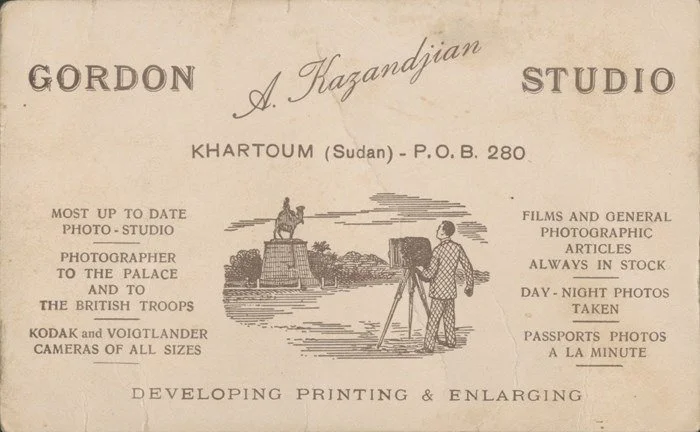
Description: ‘Gordon Photography Studio’ business card
Location: NA
Source: sudanahye archive via private collection
Through these fragments of the past and the nostalgic visualisations that accompanies them we are constructing a Sudanese-Armenian visual culture. It is constructed by searching through this nostalgia, by understanding which visuals are strongest in the minds of those who remember, and by exploring how that nostalgia has manifested. The nostalgia is for a life built on the back of commercial success, a life based around physical spaces of community and hospitable home, and ultimately nostalgia for the days captured by photos of these spaces and the people there. By constructing a visual culture, we transcend the staticness of historical research to build a dynamic legacy that can in turn help re-imagine the community in contemporary social and cultural contexts.
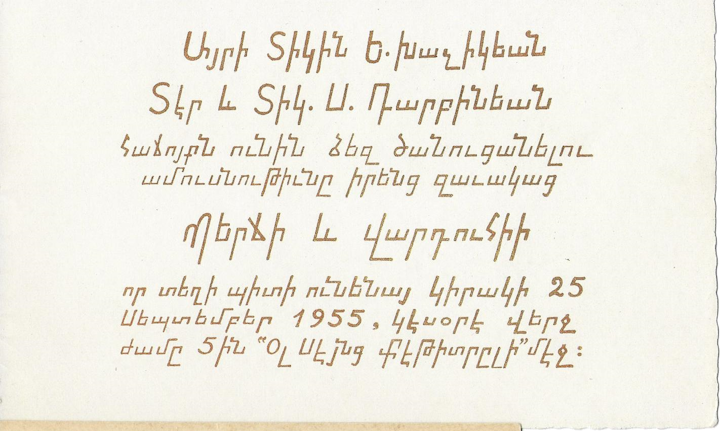
Description: An invitation to a Sudanese Armenian Wedding
Location: Khartoum, Sudan 1955
Source: sudanahye archive via private collection
Many diasporans consider their host country to be a backdrop to their life. But Sudan is not a backdrop to Armenian visual culture. Sudan is an active presence - the people, environment and culture of Sudan shaped Armenian life. Diaspora is usually invested with narratives of nostalgia, exile and loss, but the Armenian story also shows it is a place where cultures meet and new hybrid cultures are born - and in our case it is that hybrid life that is remembered with such fond nostalgia, a longing for not just the Armenia that was, but also for the Sudan that was and the Sudanese-Armenian life that was.
Do you remember Sudan?
Because Sudan’s Armenians do.

Stay updated:
Stay updated on our latest releases - give our social media pages a follow.
We would love to hear from you, whether it be a reflection on this post, a correction or a suggestion, send us an email at info@sudanahye.com.